Category Archives: Documentaries

Film festival showcases Journalism School water documentary

By Anna Barnes

An incomplete, 10-minute version of the documentary I’m co-directing, WealthWashed, was accepted into Skyfire Film Festival’s inaugural environmental film fest in Arizona.

The project received financial support from the Knight Center for Environmental Journalism.

WealthWashed is a documentary that traces Michigan’s complex relationship with its greatest asset: water. What begins as a story of recreation on the lakes shifts into a deeper look at access, equity and the pressures of climate migration.

Through voices from across the state, the film uncovers how climate gentrification is already taking shape in Michigan and why protecting our water is key to becoming a true model for climate resilience.
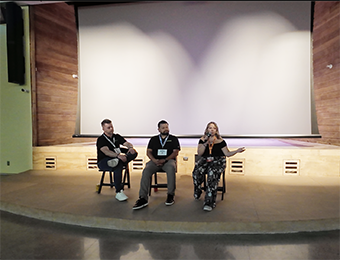
After the screening of WealthWashed, Anna Barnes, one of the documentary’s directors, participated in a Q&A session with the audience.

I was invited by the organizers of the Skyfire Film Festival in Arizona to participate in a March Q&A session about the film.

In addition to myself, the WealthWashed team consists of co-director Meg Vandermark, videographer Milo Lucas, videographer Yixuan Li and Lindsay Tague, the editor and producer.

WealthWashed was made possible by Professor of Practice Troy Hale’s Advanced Documentary Filmmaking course at Michigan State University.

You can check out our documentary website here and our instagram here. We will be announcing screenings in the East Lansing area on these platforms soon. Continue reading

MSU Latinx Film Festival returns with international films, music and conversations

MSU Latinx Film Festival returns with international films, music and conversations

By Isabella Figueroa Nogueira

The MSU Latinx Film Festival (LxFF), cosponsored by the Knight Center for Environmental Journalism, returned Feb. 19 -22 for its fourth edition, bringing international cinema, live music and conversations about immigration, environmental justice and identity to Michigan State University and venues across Lansing.

Attendees watch a film at MSU’s Latinx Film Festival. Credit: Scott Boehm.

Founded in 2018 by Scott Boehm, an assistant professor of 20th and 21st Spanish culture, the festival has grown from six films over four days into the largest Latino, Hispanic and Latin American film festival in Michigan. Nearly all of this year’s films were Michigan premieres, and more than half were Midwest premieres.

Several selections were previously screened at major international festivals, including the Berlin International Film Festival and the Venice Film Festival. Boehm said many of the films had only one or two screenings in the United States before arriving in East Lansing.

“What you’ll find is something you would expect to see in New York or Miami or Houston or San Diego or LA,” Boehm said. “But it’s in Lansing.”

This year’s lineup featured 12 full-length films and shorts from Mexico, Peru, Venezuela, Cuba, Brazil, Puerto Rico, the Dominican Republic, Spain and the United States. Topics included immigration, racism, U.S. militarism in Latin America, child sex trafficking, class, ageism and environmental justice.

Environmental justice has become a permanent part of the festival’s programming. Boehm said the climate crisis is one of the most pressing issues facing the planet and that Indigenous and marginalized communities often feel its effects first. Continue reading

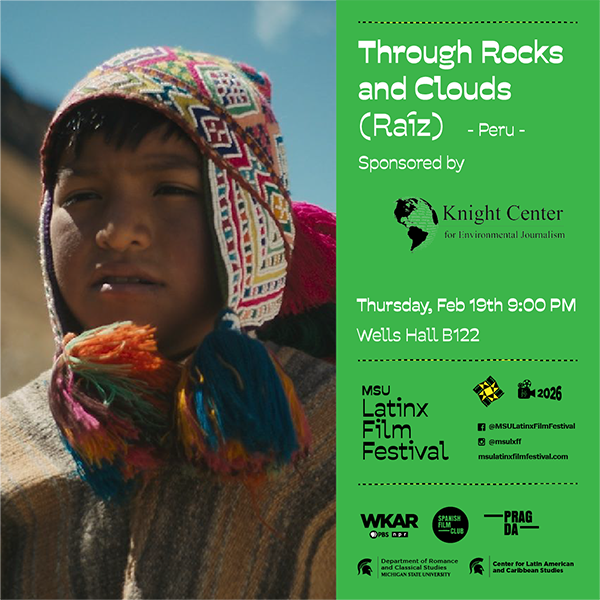
Knight Center co-sponsors two films at upcoming MSU Latinx Film Festival

The first is titled “Karuara, People of the River.” According to the festival’s website: “A vibrant hand-painted animation brings whimsical Karuara spirits to life in Peru’s Amazon. Their mission: maintain the Marañón River’s ecological balance as the Kukama people fight for the river’s legal personhood.”

J-School professor Bruno Takahashi will be presenting the film alongside one of the directors.

The second is called “Through Rocks and Clouds (Raíz).” According to the website: “Feliciano, an 8-year-old alpaca herder, feels euphoric: Peru has a chance to qualify for the World Cup. Meanwhile the pressure of a mining company puts Feliciano’s village at risk and threatens his world and his dreams.”

Both showings are free and will take place Thursday, Feb. 19 in Wells Hall.

For more information about these films and the rest of the festival, visit https://msulatinxfilmfestival.com/

Open call for 2024 proposals for high school journalism and environmental science collaborations

To encourage collaboration between high school journalism and environmental science classes, we invite teachers to submit proposals for innovative class projects in which journalism students will report about field research by environmental science students. Our principal goals are:

  • to help young prospective journalists better understand and explain to the public how science is done
  • to help environmental science students learn to use the media to explain their work to the public.
  • To promote environmental and science journalism.

The Knight Center intends to award 1-year grants of $2,000 to up to 3 high schools: $1,000 to the journalism program and $1,000 to the environmental science program for equipment, software or scholarships. In addition, the Knight Center will pair each school with a professional journalist to serve as a mentor to participating students and teachers.

Here are the details:

  • Your proposal must include a project description (750 words maximum), the names and contact information for a partnering journalism and environmental science teacher from the same high school; grade levels of participating classes; and the estimated number of students in the participating classes. A proposal form is attached.
  • Your projects must generate student-produced news or feature stories with visuals (photos and/or graphics) for print, online, audio and/or video that your school will disseminate. The Knight Center will also disseminate these stories to the public through our website, and some stories may be posted on Great Lakes Echo (greatlakesecho.org), the center’s award-winning online regional environmental news service.
  • Grantees must comply with MSU financial reporting procedures.
  • Grantees (students, teachers and professional mentors) will be invited to a one-day workshop at MSU in Fall 2025 or Spring 2026.
  • Application deadline: November 15, 2024. Awards will be announced by December 15, 2024. Projects should begin Spring 2025 and be completed with a progress report October 1, 2025 and a final report June 15, 2026.
  • Read about some successful past grantees at https://knightcenter.jrn.msu.edu/2019/03/06/four-high-schools-win-journalism-environmental-science-grants-from-the-knight-center/

Send along a Grant Application Cover Sheet with the following information:

  • School name and address
  • Participating journalism teacher (name, email, phone)
  • Participating environmental science teacher (name, email, phone)
  • Project description (750 words maximum): What do you intend to do (scientific research
    and journalistic coverage) and how? What are your goals for the project? How will you
    assess accomplishments?
  • Titles and grade levels of participating classes:
    • Journalism:
    • Environmental science
  • Name, title, email and phone of administrator authorizing submission of the proposal:

Submit by November 15 to Barb Miller at mille384@msu.edu

If you have questions, email Eric Freedman at freedma5@msu.edu