Knight Center Research Director Bruno Takahashi and doctoral researchers Iasmim Amiden dos Santos and Julia Belden participated in a series of international speaking engagements, sharing their research on environmental communication in Latin America.
Many of these presentations build on their recent co-authored publications, including an article in Environmental Communication that examines the experiences of Latin American scholars working in the field and another that explores Indigenous communication and decolonial journalism in the Peruvian Amazon.
Takahashi and Amiden dos Santos co-organized and participated in the second symposium of the Red Latinoamericana de Estudios en Comunicación Ambiental/Latin American Network for Environmental Communication Studies (Red LECA), hosted by the Universidad de La Sabana in Chía, Colombia.
The symposium focused on the relationship between democracy and environmental communication and brought together scholars from across the region to discuss emerging research and collaborative initiatives. More information about the event can be found here.

Amiden dos Santos moderating a panel on environmental journalism at the second symposium of Red LECA.
Following the symposium, Takahashi visited the Universidad de Montevideo in Uruguay and the Universidad de Buenos Aires in Argentina.
In Uruguay, he taught in the Diplomado en Comunicación, Ambiente y Sostenibilidad and presented his research on environmental journalism and science communication to faculty, students, and professional communicators. He was also interviewed by news outlets, including Canal 5 Noticias. In Buenos Aires, he delivered a lecture on the development of environmental communication research in Latin America.

Takahashi in Canal 5 Noticias, Montevideo, Uruguay

Takahashi presenting at the Universidad de Buenos Aires
Takahashi and Amiden dos Santos also traveled to Peru to conduct fieldwork for a project funded by the Climate and Land Use Alliance (CLUA). The project examines communication practices among Indigenous organizations and environmental NGOs regarding Indigenous Peoples in Isolation and Initial Contact (PIACI) in the Peruvian Amazon.

Takahashi and Amiden dos Santos leading a focus group in Iquitos, Peru.
During this visit, they also presented their research at the Universidad Científica del Sur (UCSUR) and at the Pontificia Universidad Católica del Perú. More information about these engagements can be found here. Amiden dos Santos, now a visiting professor at UCSUR, also taught a class on strategic communication.

Amiden dos Santos presenting at the Universidad Cientifica del Sur, Lima, Peru

Takahashi and Amiden dos Santos with faculty and staff at the Universidad Cientifica del Sur, Lima, Peru.
In late June, the researchers presented at the pre-conference on climate change communication and at the annual conference of the International Association for Media and Communication Research (IAMCR), held in Dublin and Galway, Ireland, respectively. Their presentations highlighted the distinctive characteristics of environmental communication research in Latin America and emphasized the importance of expanding opportunities for scholars from the region to share their perspectives in international academic forums.

Amiden dos Santos presenting at IAMCR in Dublin.

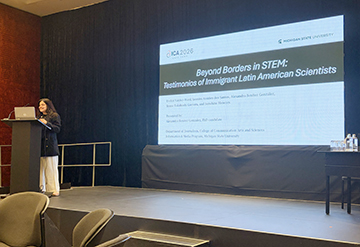
Julia Belden presentng at ICA in Cape Town, South Africa
Incoming doctoral student Julia Belden presented at the conference of the International Communication Association conference in Cape Town, South Africa. The study, a collaboration with Takahashi and Amiden dos Santos, presents an analysis of the environmental communication academic literature from Latin America.
Later this summer, Takahashi and Amiden dos Santos presented research on decolonial environmental journalism in Bolivia and Indigenous decolonial communication in the Peruvian Amazon at the annual conference of the Association for Education in Journalism and Mass Communication (AEJMC) in New Orleans.
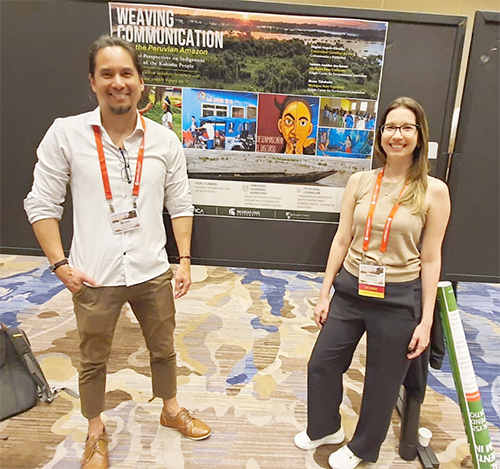
Takahashi and Amiden dos Santos presenting at AEJMC in New Orleans.
These international engagements reflect the Knight Center’s commitment to advancing environmental communication research and fostering collaborations with scholars, journalists, and practitioners around the Latin America. By sharing research and building partnerships across the region, the Center continues to contribute to more inclusive and globally connected conversations about environmental communication.