Author Archives: Barb Miller

Public radio environmental reporting intern reflects on the experience

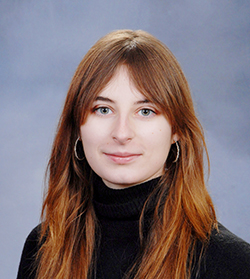
By Clara Lincolnhol

Clara Lincolnhol

My Knight Center summer internship with PBS/NPR-affiliate WKAR in East Lansing recently came to an end. It’s safe to say the expectations I had going into the job were exceeded. I walked away feeling like I had grown significantly, both as a person and a reporter.

Throughout this internship, I worked as an environmental news and radio reporting intern. I had the opportunity to localize my favorite beat to the community I live in. It was incredibly fulfilling covering my own and other nearby communities in Mid-Michigan and being a part of both local journalism and public media.

Having the opportunity to go on-site and interview people who were directly involved in or affected by issues was an immensely valuable experience.

A challenge I faced was adjusting to writing for radio and then voicing it. As someone used to print, it was difficult at times to effectively cut back what I was trying to say into verbiage better suited for a spoken, minute time slot. Thankfully my mentors at WKAR gave me great guidance. I felt that towards the end of my internship, I better understood how to write engaging copy + record a voiceover–and found it fun too! Continue reading
Knight Center researchers present studies on environmental journalism in Latin America

Knight Center director Eric Freedman and Knight Center doctoral student and research assistant Iasmim Amiden dos Santos presented two papers on environmental journalism in Latin America at the 2025 Association for Education in Journalism and Mass Communication (AEJMC) conference, held August 7-10 in San Francisco, California.

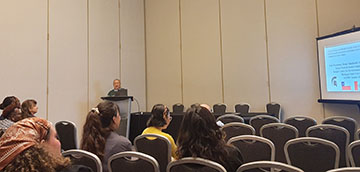
Eric Freedman presenting at AEJMC

Freedman presented a case study of three Knight Center training programs for professional journalists and students in Bolivia, Chile and Peru. The programs were designed to strengthen skills, expand networks and build knowledge of environmental science and policy, while adapting to each country’s social, political and environmental context.

Freedman also addressed the challenges of conducting training during the COVID-19 pandemic, when the Peru program shifted to a virtual format. Despite those hurdles, Freedman stressed the benefits of these initiatives in improving accuracy, ethics and fairness in reporting – especially in contexts with limited funding for investigative work, restrictions on press freedom and physical or legal threats that undermine journalists’ ability to cover environmental degradation and related social conflicts. Continue reading

Knight Center researcher among AEJMC Diversity and Inclusion Career Development Fellows

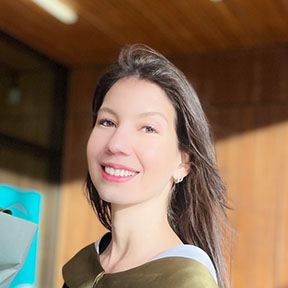
Iasmim Amiden dos Santos

Doctoral student and Knight Center research assistant Iasmim Amiden dos Santos was selected as one of this year’s Association for Education in Journalism and Mass Communication (AEJMC) Diversity and Inclusion Career Development Fellows. Organized by the Mass Communication & Society Division, the program supports graduate students from historically underrepresented groups in the U.S. as they prepare for academic and professional careers in communication fields.

Amiden dos Santos, from Brazil, researches environmental journalism practices, the roles of journalists, and discourses surrounding environmental issues and Indigenous peoples in Latin America. “I see this fellowship as a chance to strengthen my path while supporting more equitable representation in academia and media,” said Amiden dos Santos. Continue reading

Knight Center Researchers Share Work at International Conference

Three Knight Center for Environmental Journalism researchers presented their work at the Conference on Communication and the Environment, held June 23–27, 2025, at the University of Tasmania in Hobart, Australia.

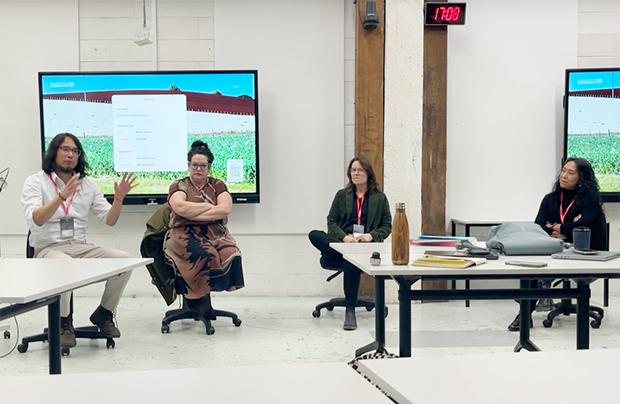
Research Director Bruno Takahashi  presented the ongoing project, “The Discursive (De)construction of Oil Spills: A Case Study of Mediaciones in the Peruvian Amazon.” The project, in collaboration with doctoral student Iasmim Amiden dos Santos, combines in-depth interviews with journalists, Indigenous communicators and community members, with participant observation and media content analysis, to unpack how oil spills are framed and contested.

Bruno Takahashi during the discussion of his study

Takahashi also joined the panel “Publishing Environmental Communication: From Aggravations to Aspirations,” sharing insights from his experience as an editor and highlighting ways to make academic publishing more accessible to researchers in the Global South.

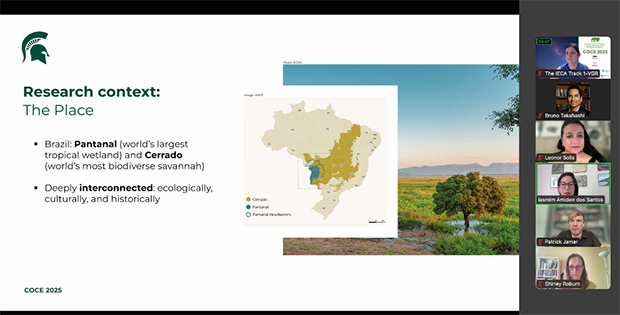
Amiden dos Santos also showcased her study, “Ecofeminist and Ecocentric Discourses in Brazilian Independent Media Coverage of the Pantanal and Cerrado.” Her discourse analysis revealed how two independent news outlets in Brazil broke from conventional journalism norms to center marginalized voices, reflecting ecofeminist, anti-capitalist and decolonial perspectives.

Iasmim Amiden dos Santos presenting virtually her study

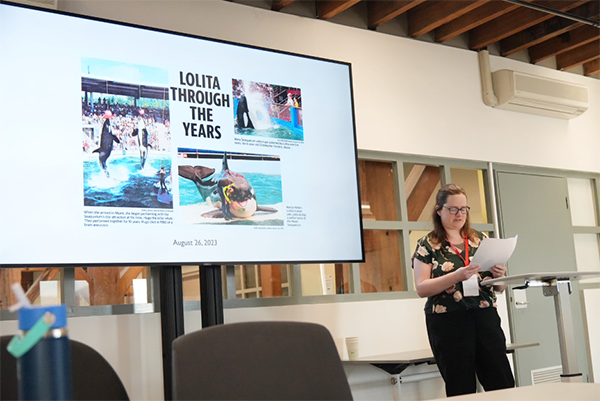
First-year MA student Julia Belden presented “A Killer Whale Tale: An Analysis of The Miami Herald’s Coverage of the Orca Tokitae from 1970 to 2023.” Her work traced how the newspaper’s coverage shifted over five decades—from entertainment and spectacle to animal welfare, business, and conflict—capturing evolving public attitudes toward a single, iconic animal.

Julia Belden presenting her study

Belden also participated in the conference’s pre- and post-events. The pre-conference brought together graduate students from around the world to share experiences and learn about academic scholarship from senior researchers. The post-conference was a Deep Ecology workshop that invited participants to deepen their connection with nature through guided reflection and immersive activities.

These presentations and activities highlight the Knight Center’s expanding role in global conversations on environmental journalism and its commitment to fostering research with international reach and impact.