Category Archives: Eric Freedman

Eric Freedman is the director of Michigan State University’s Knight Center for Environmental Journalism

Five science writers share tips on how to make science stories entertaining and funny

Five science writers share tips on how to make science stories entertaining and funny

By Clara Lincolnhol

This is the 6th in a series of articles by Knight Center students who attended the recent annual conference of the National Association of Science Writers.
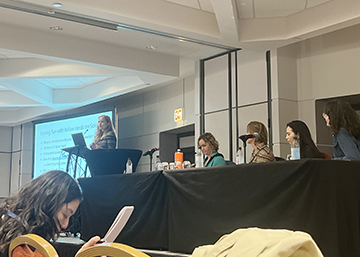
“Welcome to how to engage an audience,” said Kathyrn Jepson, the editor-in-chief for Symmetry Magazine and a science fiction editor.

Jepson and four other journalists spoke at a panel at the National Science Writers Conference in Chicago to share how writers can implement humor in their writing to get readers hooked on a scientific story.

Blythe Terrell, the executive editor at Science Vs., said a critical way to tell a funny science story is by getting the scientist in on a joke.

“One of the critical ways we do that is by giving scientists a space where they hopefully feel comfortable opening up and having just a little bit of fun,” Terrell said. “And that is often on our tape in our audio.”

She said they will write weird questions and see if the scientist wants to go along with them.

“It’s not like we aren’t taking the topic seriously. We are treating it with seriousness. The rest of the episode is serious, but we find space for these things and we find that really engages listeners,” Terrell said.

Kate Gammon, a comedian, and freelance journalist, said she writes a lot about crises, like the biodiversity crisis, the climate crisis and political crisis. “It felt sometimes like I was writing an obituary for nature,” Gammon said. “So I had to make jokes.” Continue reading

NASW EDITORS

Editors are people too!

By Julia Belden

This is the 5th in a series of articles by Knight Center students who attended the recent annual conference of the National Association of Science Writers.

It’s a scenario every journalist is familiar with: You file what you think is a solid draft of a story, only to find it covered in red ink and comments upon its return from the editor’s desk.

Editing is a critical part of the writing process, yet there is frequently tension between writers and editors. At the recent National Association of Science Writers conference, a panel of editors and freelance writers took to the stage to offer their insights into this relationship.

At the heart of it all? “Do unto others.”

“Number one is treat your writers the way you wish you would be treated if you were a writer,” said Sarah Zielinski, the print editor for Science News Explores.

Attendees at the National Association of Science Writers list helpful and frustrating editor behaviors. Credit: Julia Belden

This means giving feedback with kindness and intention, the panelists continued.

Carmen Drahl, a freelance journalist and editor, cautioned editors about word choices when editing: “Never underestimate the emotional impact that a glib comment or off-the-cuff comment can have.”

The panelists recognized the inherent power imbalance between editors and writers. Freelance writers are in an especially precarious position, as money might not flow as steadily as it would in a staff writing job.

Because of this dynamic, writers might be hesitant to reach out for help when they need it, the panelists said.

Whether it’s a scheduling issue, a personal emergency or you’re simply stuck on something in a story, it’s important to communicate. Editors want to help, said the panelists. Continue reading

Knight Center team attends science writers conference

Five environmental journalism students and Knight Center director Eric Freedman attended the recent annual conference of the National Association of Science Writers in Chicago.

They were undergrads Clara Lincolnhol, Emilio Perez Ibarguen and Isabella Figueroa Nogueira and master’s students Shealyn Paulis and Julia Belden.

Topics ranged from skill-building such as editor-freelance relations, using data in stories, making science videos and how reporters can conduct their own mini-investigations to issues such as the future of U.S. science, AI and data centers, nuclear weapons and the brain drain.

The students will be writing stories for the Knight Center website and Facebook page and the Journalism School’s Facebook page on lessons learned from the conference.

Also attending the conference from MSU were Knight Center master’s alum Ruth Thornton, university science public relations manager Emilie Lorditch, outreach specialist and MSU alum Ana Becerril of the Facility for Rare Isotope Beams and Angela Prete, a graduate student in microbial & molecular genetics.


High school students visit Knight Center

Troy Athens High School students

Students from three Southeast Michigan high schools recently spent a day at the Knight Center, learning about environmental journalism and touring the School of Journalism, the Spartan Newsroom and the WKAR TV studios.

Kelly House, the environmental reporter at the nonprofit Bridge Michigan news service, spoke to the students and teachers at lunch.

Skyline High School and Huron High School in Ann Arbor and Troy Athens High School received Knight Center grants for their journalism and environmental science students and teachers to develop collaborative media projects.

Huron High School students

As part of the grant program, the Knight Center also arranged for former reporters Nancy Hanus and Ron Recinto to serve as professional mentors to the teams.

In “Why Native Plants,” the Troy Athens team explored the push and rationale to use native plantings at the school district’s new construction sites. Here’s the presentation and video about the project.

The Huron team looked at how students used wildlife tracking cameras to study biodiversity and Miller Creek, which runs into the Huron River. Its presentation is here.

Skyline High School students

“Skyline’s Salamanders & Wetlands” is an account of ongoing efforts to protect an endangered salamander on the high school’s grounds. The team’s presentation is here.