Category Archives: Uncategorized

ATTRIBUTION SCIENCE

Attribution science: Reporting on extreme weather in the context of climate change
This is the 8th in a series of articles by Knight Center students who attended the 2026 annual convention of the Society of Environmental Journalists.

By Anna Ironside

Journalists and climate experts gathered during the Society of Environmental Journalists conference in Chicago to discuss how attribution science is helping reporters explain the connection between climate change and extreme weather while improving the public understanding of different climate impacts.

The panel was moderated by Ethan Brown, a training program coordinator at the Metcalf Institute at the University of Rhode Island, who said attribution science helps answer questions communities increasingly ask after disasters.

Speakers (left to right) Ethan Brown, David Yeomans, Kelesha Williams and Shel Winkley. Credit: Anna Ironside

“Attribution science is an emerging field that allows us to answer a question that communities are increasingly asking: how climate change influenced an individual extreme weather event,” Brown said.

Attribution science is a field of research that finds how much human-caused climate change influenced the intensity or likelihood of a specific weather event.

Shel Winkley, a senior engagement specialist and meteorologist at Climate Central, explained that attribution science uses climate models to compare with and without human-produced carbon emissions to find out how climate change affected the likelihood or intensity of a weather event.

“What attribution science can tell us is it tells us how much more likely was that hot temperature, or that record heat,” Winkley said. “How much more likely, or how many more times could we see this happen as we continue into the future?”

Attribution science does not determine that climate change created a weather event.

“It does not say that a weather event was made by climate change,” Winkley said. “A hurricane is going to be a hurricane.”

Shel Winkley explains how climate change intensified March’s Western heatwave, making extreme temperatures at least three times more likely for 42.5 million people. Credit: Anna Ironside

He further explained that attribution science shows how climate change can cause weather events to intensify.

“We understand that humans added more intensity and more rainfall to that hurricane,” Winkley said.

Winkley said attribution science helps journalists explain climate change in ways that audiences can understand.

“It helps make that big abstract thing of climate change,” Winkley said. “It helps people understand it. It personalizes it, it starts those conversations.”

Television Jamaica reporter Kalisha Williams said she had this in mind and used this approach while covering Hurricanes Beryl in 2024 and Melissa in 2025. Williams said her initial reporting focused on immediate community needs rather than on climate change.

“In the immediate aftermath, the focus is on what’s happening now, getting relief to people,” Williams said. “People want to know where they can get help.”

As recovery efforts continued, Williams said she began reporting on the science behind the storms.

“By week two, I started making the connection to say, okay, this happened now, but there may be more like Hurricane Melissa in the future,” Williams said. “What is causing this? How is climate change helping in terms of the rapid intensification of these hurricanes?”

Williams has continued to encourage journalists to continue climate reporting beyond the initial disaster.

CBS Chicago meteorologist David Yeomans spoke on how attribution science provides viewers with context about changing weather patterns.

“I see it as an important bit of context to give our viewers and our audience, sort of the bigger why behind some of our weather patterns,” Yeomans said.

Yeomans said research suggests tornado activity has shifted eastward in recent decades.

“What we’ve seen over the last 40 years, there’s fewer tornadoes in places like Texas and Oklahoma,”

Shel Winkley explains what attribution science can and cannot tell us regarding climate. Credit: Anna Ironside

As of now, scientists cannot confidently attribute individual tornadoes to climate change, Yeomans said reporters can still use the broader scientific findings in their reporting, and Brown explained that attribution science does not have to become the central focus of every climate story.

Winkley encourages journalists to use available scientific resources and continue building confidence when covering climate issues.

“You’re not going to always do it perfectly, and that’s okay,” Winkley said.

He said even a brief mention of attribution science can help readers understand the role that climate change plays in extreme weather.

Anna Ironside
NACHUSA GRASSLANDS

Nachusa Grasslands restoration: Invasives, controlled burns and seed harvests

This is the 7th in a series of articles by Knight Center students who attended the 2026 annual convention of the Society of Environmental Journalists.

By Anna Ironside

For over 40 years, restoration efforts have been happening at a prairie in northern Illinois.

The Nachusa Grasslands near Franklin Grove has a team of scientists and volunteers helping to rebuild the endangered ecosystems through seeding and scheduled controlled burns.

Nature Conservancy researchers spoke on how the goal for the prairie is to aid in reassembling the ecological process that had sustained the land for thousands of years.

According to the Nature Conservancy website, in 1985 a small area of tracts in what is now the preserve went up for sale. Many donors and supporters contributed, which helped the Nature Conservancy buy the land at auction. At the end of 1986, TNC owned 397 acres.

“Our goal here is to set up the tallgrass prairie ecosystem for success into the future,” said Elizabeth Bach, a research scientist based at Nachusa.

“We’re talking about bringing these plants, animals, soils and ecosystem functions and processes back together to thrive and persist into the future, knowing that the future looks quite a bit different than our past has.”

She was speaking to members of the Society of Environmental Journalists who visited Nachusa as part of their annual conference.

Bach, who specializes in soil and plant ecology, said restoration at Nachusa depends on two of the prairie’s most important forces: fire and seed. Every year, the land managers conduct prescribed burns across sections of the preserve to mimic the natural and Indigenous-set fires that historically shaped the area.

“We do prescribe fire in a way that is very conscious of achieving our ecological goals,” Bach said. “There’s a lot of planning that goes into it. We have a written plan, we have to get smoke permits, and we all are trained.”

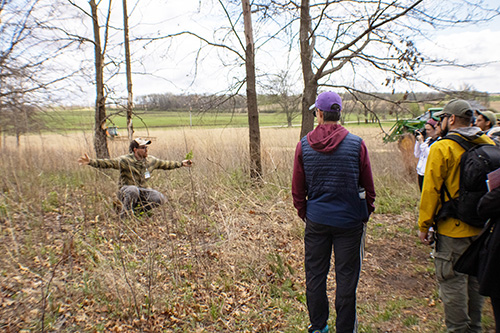
Tyler Pellegrini, plant and soil ecologist at the Machusa Grasslands, explaining prescribed fires to a group o SEJ members. Credit: Anna Ironside

She explained that crews of researchers and volunteers use carefully planned ignition patterns to better control the direction and intensity of the burn.

“You start on the downwind side and light what’s called a backing fire that burns real slow and controlled into the unit,” Bach said. “Then you burn along the sides – that’s a flanking fire – and then by the end, you light one head fire and the winds push it far into the unit.”

These burns are not only a management tool, but they also clear out invasive species and recycle nutrients, while triggering native plant growth.

“We can suppress that brush by doing prescribed fire very frequently,” Bach said, referring to invasive woody plants like honeysuckle.

The burns are only one step in the process of rebuilding the prairie. Seeding is another large part of the restoration effort.

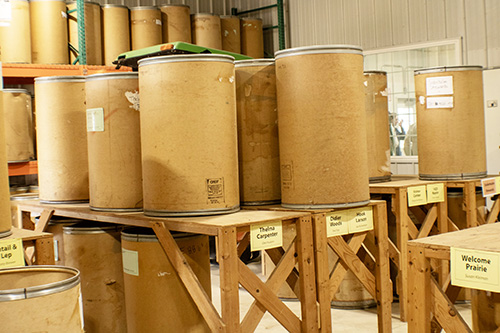
Dozens of barrels of different seeds are processed and ready for distribution across the Nachusa Grasslands. Credit: Anna Ironside

Staff and volunteers collect and distribute millions of native seeds every year, working to reconstruct the plant communities that were plowed under for agriculture over a century ago.

“If you don’t put enough seed down, you get a lot of invasive species pressure,” Bach said.

Years of studies and research at Nachusa have helped to determine how much seed is needed to build up diverse prairie communities, which have been a useful guide for restoration work throughout the Midwest.

“Most years we have around 30 research projects happening at the preserve and we’re collaborating widely across a lot of universities and research agencies,” Bach said.

Bach added that the results are slow but measurable.

In the early years, newly seeded fields filled with weeds before native species established themselves in the soil. Over time, diversity has increased, and deeper-rooted prairie plants have stuck around.

“Usually, in five to eight years, you’re seeing most of the species that you’ll end up seeing,” Bach said. “But restoration is kind of a never-ending process.”

The brown grass towards the back of this photo shows previously controlled burns on the prairie at Nachusa Grasslands. Credit: Anna Ironside

Prairie soils can regain carbon over decades, but full restoration takes much longer.

“About 80 to 90% of that happens in the first probably 50 to 80 years,” she said. “But to get back to remnant prairie levels, it’s probably going to take 150 to 300 years.”

The combination of fire, seed and long-term monitoring is reshaping how conservation is done in the area and other parts of the region.

“We’ve tried some things, we’ve learned some lessons, we’ve made changes,” Bach said. “We’re summarizing all of these plantings and how our practices have changed and how the resulting prairie outcomes have changed.”

Some of the approximately 130 bison that roam the Nachusa Grasslands. They were reintroduced to the land in 2014. Credit: Anna Ironside

When talking about the future and the long timeline that this work is on, Bach sounds hopeful, and her organization will continue to do work that cannot be measured by just a few seasons.

“We want to see this ecosystem thrive for generations to come,” she said. “We do things every day that we know we are not going to see the outcome or the rewards of.”

Anna Ironside

The importance of international connection-making for environmental journalists.

This is the 6th in a series of articles by Knight Center students who attended the 2026 annual convention of the Society of Environmental Journalists.

By Joshua Kim

Hundreds of environmental journalists from universities and organizations attended the 2026 conference of the Society of Environmental Journalists held in Chicago.

Many were from American-based organizations. However, there was a significant number of international journalists as well.

Mats Hellmark, a journalist from Sverige Natur in Sweden, came to the conference after hearing of its great reputation over the years.

Hellmark said that learning about different perspectives in journalism, between the Swedish way and the American way, was important, and that he felt he and the American contacts he met learned a lot from each other.

He also added that SEJ seems to be doing more to attract more international journalists and organizations to attend.

“I think this may be the biggest forum for these kinds of issues today, even though it’s a U.S. society,” Hellmark said. “In these times, we certainly need to support each other doing work in this field, as it’s a tough situation in many respects.”

Especially with environmental topics, multiple international perspectives are crucial, Hellmark said. Continue reading

INVESTIGATIVE TOOLS

Journalists need to know, use, Freedom of Information laws and other investigative tools

This is the 4th in a series of articles by Knight Center students who attended the 2026 annual convention of the Society of Environmental Journalists.

By Victoria Witke

All journalists, regardless of the size or power of their outlet, should be building investigative techniques and culture into everything they produce. That’s an attainable goal and essential in improving news credibility and readership, Adam Rhodes said during the Society of Environmental Journalists’ 35th annual conference in Chicago.

Rhodes is an investigative journalist covering queer people in the legal system. Rhodes also doubles as the editor and training director at Investigative Reporters and Editors.

During the conference, Rhodes led a learning session titled “How to Be an Everyday Investigative Watchdog,” an hour-long crash course on incorporating investigative work into daily newsgathering to create beefier stories. The room was packed with dozens of attendees equipped with notebooks, recorders and pens.

“Our chief job as the press is to hold people accountable,” Rhodes said at the beginning of the session. “What else?”

“Uncover stories that matter to readers that aren’t just being a stenographer,” one audience member replied.

Adam Rhodes. Credit: Missouri School of Journalism/University of Missouri

“Yes, absolutely,” Rhodes agreed. “Think of everything that we would not know about our nation, the government, the way that the world really works and moves without journalists asking extra questions.”

Rhodes said public records – things like databases, reports and documents – are rich in investigative story ideas and a matter of filing a Freedom of Information Act request. But, Rhodes said, the majority of investigative work is about a reporter’s mindset – not the easy-to-teach skills like filing a FOIA or finding a dataset on a government website.

“The most important thing is the desire, interest and commitment to do this work well,” Rhodes said.

Yet, there’s a lot of pressure, especially on small newsroom reporters, to turn out stories quickly. Journalists might have limited time to sift through troves of numbers or jargon-filled legal reports. Outlets may not subscribe to services like LexisNexis. Continue reading