
Herd of bison change the work of species and ecological restoration
 This is the 10th in a series of articles by Knight Center students who attended the 2026 annual convention of the Society of Environmental Journalists.
By Akia Thrower
Bison at the Nachusa Grasslands shape species and ecological restoration throughout the Midwest region, highlighting the future of conservation efforts and the maintenance of natural habitats.
The Nachusa Grasslands, a more than 4,000-acre nature preserve in Illinois operated by the Nature Conservancy, is home to a herd of bison. Researchers work with them to restore the historic bison population in the region.

Herd of bison, all females, graze on fresh grass. Credit: Akia Thrower
“Most of the herd are females, as males are solitary, or in bachelor groups that come during the mating season,” said Cody Considine, the deputy director of the preserve. He was talking with members of the Society of Environmental Journalists.
Considine said that bison are normally gentle and docile when interacting with humans from a distance, with vehicles not seen as a threat. Bison usually attack when people are close to them and don’t respect their boundaries.
“The bison are usually a bit nervous when there are people walking through the land, but they are usually really calm around vehicles,” he said.
“On television, when you see buffalo attack people, that’s hours and hours of people being in their personal space for selfish reasons, like getting the perfect photo. Otherwise, they are really docile creatures and are very, very gentle animals.”
He said that researchers try to maintain the natural integrity of the herd with little human interference.
“Here, we try to let buffalo be buffalo in this area,” Considine said.
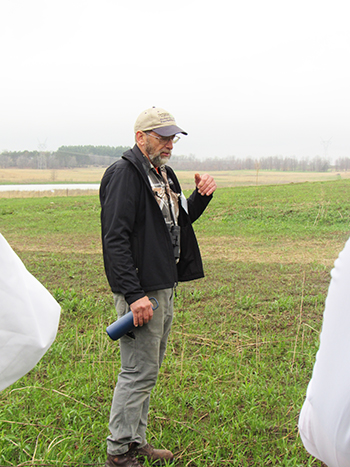
Bill Kleiman, the project manager of the preserve, speaks to members of the Society for Environmental Journalists. Credit: Akia Thrower
Bill Kleiman, the project manager of the preserve, added that domestication of the species particularly concerns the researchers when interacting with the herd.
“Domestication is a concern for the next 20 years. Everything we do, it has an effect. We are concerned about slowly taking the wildness out of the species,” Kleiman said.
Bison became a keystone species in the area through their grazing patterns and building wallows, which are dust bowls dug into the ground.
“Bison dig with their horns on the side of the prairie, and that creates a dust bowl, called wallows. It is a kind of social thing and they roll around in the dust,” Kleiman said.
Kleiman said the wallows benefit multiple species in the preserve. For example, wallows hold water and are homes to insects and animals.
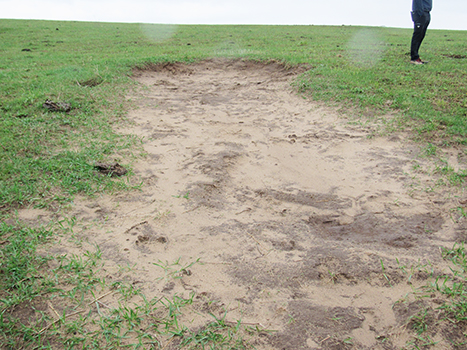
A wallow created by bison on the nature preserve. Credit: Akia Thrower
“Wallows are also places for nested bees. Nachusa is known to have one of the highest diversity of bees,” Considine said. “Box turtles also use these wallows to create their nests.”
Every year, the bison follow the freshly burned land to graze on the new sprouts of grass that emerge.
“Their grazing shapes the ecosystem and is a key part of ecosystem restoration,” said Considine.
The bison bridge also gaps in the region at other conservation sites, and the relationship between the conservancy and national Indigenous communities.
“Every year, we remove about 30 buffalo to go with our travel partners that focus on helping other conservation sites build their herds throughout the region,” Considine said.
Considine said that the conservancy has transferred over 60 bison to Indigenous communities through the InterTribal Buffalo Council, a tribal organization that works to restore this species for Indigenous peoples.
“There are also cultural harvests for the Indigenous communities, and we are learning about that and supporting those communities,” he said.
Bison shape the perspective of the relationship between people and the land, and ensure responsibility for the land as stewards, he said.
“My work helps me think about the relationship with the land, not only as a conservation effort, but also how we can better become stewards of the land,” Considine said.

Akia Thrower
