
Five science writers share tips on how to make science stories entertaining and funny
By Clara Lincolnhol
 This is the 6th in a series of articles by Knight Center students who attended the recent annual conference of the National Association of Science Writers.
“Welcome to how to engage an audience,” said Kathyrn Jepson, the editor-in-chief for Symmetry Magazine and a science fiction editor.
Jepson and four other journalists spoke at a panel at the National Science Writers Conference in Chicago to share how writers can implement humor in their writing to get readers hooked on a scientific story.
Blythe Terrell, the executive editor at Science Vs., said a critical way to tell a funny science story is by getting the scientist in on a joke.
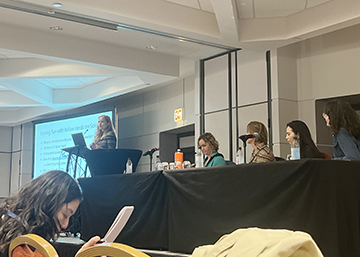 “One of the critical ways we do that is by giving scientists a space where they hopefully feel comfortable opening up and having just a little bit of fun,” Terrell said. “And that is often on our tape in our audio.”
She said they will write weird questions and see if the scientist wants to go along with them.
“It’s not like we aren’t taking the topic seriously. We are treating it with seriousness. The rest of the episode is serious, but we find space for these things and we find that really engages listeners,” Terrell said.
Kate Gammon, a comedian, and freelance journalist, said she writes a lot about crises, like the biodiversity crisis, the climate crisis and political crisis. “It felt sometimes like I was writing an obituary for nature,” Gammon said. “So I had to make jokes.”
She said there are plenty of similarities between science writing and stand-up comedy, like showing up with confidence and grabbing someone’s attention immediately, both in writing and on the stage.
Another is keeping the narrative tight in either a stand-up bit or in a news story, and using patterns when you’re writing, like the “rule of threes” where you save the punchline or the most significant information for last.
“In comedy we use the rule of three to introduce an idea, develop it and then deliver the punchline in the third,” Gammon said. “So, John Stewart has a joke that goes, “I celebrated Thanksgiving in the old-fashioned way. I invited everyone in my neighborhood to my house. We had an enormous feast, and then I killed them and took their land.”
Using analogies and doing “callbacks” is another way to convey humor and bring people along through the story before closing it out nicely at the end. She said this can build empathy with an audience.
She said research on comedy has shown that it can open people up, especially on topics where they may be resistant.
“When we put on our fancy hats and we’re so serious and we ignore the world of culture and comedy, we lose,” Gammon said. “So, this is my call to action that everyone should learn these skills and use them in your writing.”
Comedian and writer Peter Jurich said a big part of doing stand-up comedy and writing is asking yourself questions about what kind of writer you want to be and how you want to make an audience feel.
“I want to make people feel informed and educated, ” Jurich said. “But also, I’m not a super serious person, so I want people to have fun along the way. When people disagree with him or heckle him, he said it’s important to him to respond in a way where people don’t feel terrible about themselves.
He said keeping a dialogue open in that way can lead to more successful interactions.
Science writer and actor Madeline O’Keefe said most people are surprised when they hear that she acts in Shakespearean plays but also writes about physics. She said when she thinks about it there’s more in common than you’d think.
“Both science writing and Shakespeare performance start with a source written in English but that English is also filled with some unfamiliar language, maybe jargon, and overall that source can be kind of intimidating or inaccessible, and hard to understand for nonexperts,” O’Keefe said.
She said writers and actors use tools to make a reader or observer understand. For writers it’s through using words like analogies, or the way an article is structured while actors use things like tone of voice, vocal inflection, pace or volume.
“I ask myself, does it read? Is the intention getting across?” she said.
She said many times Shakespearean plays are stories we’ve heard before and the same can be said about certain scientific topics, but every writer and actor brings a different spin on them.
“Even if there are many topics that are repeated, we as writers bringing that flavor from our lifetime of experience,” O’Keefe said.
Jepson, an editor of science fiction and science writing, says she uses a particular editing tool called the MICE quotient. Each letter stands for a particular type of story.
“M” is the “Milieu” story, or where what matters is a place. Usually a character goes to an unfamiliar place and then returns home.
“I” is the idea or inquiry story where a question is raised at the beginning of a story and isn’t answered until the end.
“C” is a character story where a character is uncomfortable is some way and has an internal conflict.
“E” is an event story where a character experiences the effects of an event. The story ends when the character resolves the effects of the event and puts the world back together again.
All these types of stories have tension, and what takes the reader through the story is wanting to see if that tension is resolved, she said.
She said usually stories are not that simple and have many sources of tension.
“What matters is thinking about what the first source of tension is in the story, and if it is the last source of tension that is resolved,” she said. “Because if it is, that often makes the story feel complete and satisfying.”

Clara Lincolnhol