
Editors are people too!
By Julia Belden
 This is the 5th in a series of articles by Knight Center students who attended the recent annual conference of the National Association of Science Writers.
It’s a scenario every journalist is familiar with: You file what you think is a solid draft of a story, only to find it covered in red ink and comments upon its return from the editor’s desk.
Editing is a critical part of the writing process, yet there is frequently tension between writers and editors. At the recent National Association of Science Writers conference, a panel of editors and freelance writers took to the stage to offer their insights into this relationship.
At the heart of it all? “Do unto others.”
“Number one is treat your writers the way you wish you would be treated if you were a writer,” said Sarah Zielinski, the print editor for Science News Explores.
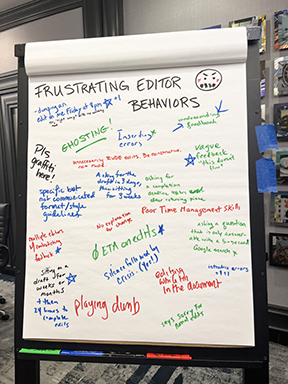
Attendees at the National Association of Science Writers list helpful and frustrating editor behaviors. Credit: Julia Belden
This means giving feedback with kindness and intention, the panelists continued.
Carmen Drahl, a freelance journalist and editor, cautioned editors about word choices when editing: “Never underestimate the emotional impact that a glib comment or off-the-cuff comment can have.”
The panelists recognized the inherent power imbalance between editors and writers. Freelance writers are in an especially precarious position, as money might not flow as steadily as it would in a staff writing job.
Because of this dynamic, writers might be hesitant to reach out for help when they need it, the panelists said.
Whether it’s a scheduling issue, a personal emergency or you’re simply stuck on something in a story, it’s important to communicate. Editors want to help, said the panelists.
Editors on the panel shared their tips for a smooth writing/editing process.

Attendees at the National Association of Science Writers list helpful and frustrating editor behaviors. Credit: Julia Belden
One recommended requiring writers to submit a story outline before starting interviews and drafting. Another encouraged editors to learn how their publication’s payment system operates so they can make sure writers are paid in a reasonable amount of time.
Zielinski said making the process as clear as possible cuts down on problems later.
“Write down your expectations from the assignment — all of the details about writing for your publication — because if it’s written down, then there is no room for interpretation,” she said.
And, if you haven’t heard from an editor in a while, try to get in touch. If you don’t get a response, try contacting someone else on their team, said Zielinski.
“If I wasn’t available, I would expect freelancers to reach out to other editors on our staff, and eventually someone should respond to you. If everybody in that publication is ghosting you, there’s probably a big problem with that publication, and I would be worried about their existence.”
Kendall Powell, a senior editor for Nature Careers, said ghosting isn’t always intentional. “It happens because editors are extremely busy people.”
Meetings, administrative responsibilities and other tasks take up significant chunks of editors’ time, Powell said, so she doesn’t get angry about writers contacting her for updates.
“In fact, I welcome those nudges and pokes and constant like, ‘Hey, you’ve had my draft for like, a few weeks now. When can I expect it back?’ That is completely reasonable for any freelancer to ask any editor,” she said.
Julia Belden
