Category Archives: Students

 
Journalism and non-journalism students at Michigan State University explore how to better report environmental issues to the public at the Knight Center for Environmental Journalism.
 

Environmental journalism courses can help students meet the School of Journalism’s elective requirements. They can also be used as part of an environmental theme to complete the school’s concentration requirement by combining them with environment-related courses outside the journalism program. See your academic adviser or contact the Knight Center.
 
Non-journalism students interested in environmental issues are encouraged to contact instructors to discuss waiver of pre-requisites. Often a journalism environmental course may meet communication course requirements of other departments.


Undergraduates are also encouraged to join the student Environmental Journalism Association and write for Great Lakes Echo to gain resume-building experience and clips.
 
Undergraduate students are eligible for several awards and scholarships in environmental journalism.
 
They are encouraged to augment their study with environment classes and programs elsewhere at MSU such as the Residential Initiative on the Study of the Environment.


New age of safety measures for environmental journalists reporting from the Amazon

By Shealyn Paulis

Shealyn Paulis

This is the 4th in a series of articles about reporting skills by Knight Center students who attended the 2025 Society of Environmental Journalists conference.

Reporters working in or focusing on the Amazon rainforest are forced to take extreme safety measures while doing so. That’s because their coverage threatens industries seeking to exploit  the region’s resources and populations.

At the 2025 conference of the Society of  Environmental Journalists in Tempe, Arizona, this topic was presented by representatives from the nonprofit organization Brazilian Association of Investigative Journalism (Abraji); security manager Valeria Oliveira and project coordinator Reinaldo Chaves.

The panel was hosted in two languages, Portuguese and English, and was part of an effort to answer why journalists in certain regions, like the Amazon, are put into such dangerous positions and how those threats are combated in the field.

Attendees were guided through a presentation on how Abraji funds, trains and mentors reporters investigating environmental crimes in the Amazon, leading to eight successful investigations thus far. Their organization advocates transparency and prioritizes journalists’ ability to have creative freedom to deliver the stories they want, but reinforces that physical security is the most important aspect of their work.

Latin America is the most dangerous place in the world to be an environmental journalist, according to a 2022 study by the international organization Committee to Protect Journalists.. The Amazon region is under particular stress, according to Reuters. In the past decade, over 200 incidents against journalists, such as threats, kidnappings and murders, have been documented. Continue reading →

Cultivating a culture of climate adaptive capacity

This is the 4th in a series of articles about reporting skills by Knight Center students who attended the 2025 Society of Environmental Journalists conference.

By Mia Litzenberg

Mia Litzenberg

Experts are looking beyond climate resiliency to build adaptive capacity, a process for navigating changes to cultural lifeways that promotes living well – not just bouncing back.

The ability to be climate-resilient suggests that people will bounce back to their previous ways of life – a paradigm that is being reshaped altogether.

“I’m keenly aware of the problematic word ‘resilience,’ especially as an academic,” said Knowledge Exchange for Resilience Executive Director Patricia Solís. “We often are now using adaptive capacity to signal that it’s a building process.”

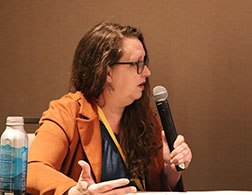
Patricia Solis discusses her work on climate adaptation at Arizona State University. Credit: Mia Litzenberg

Solís spoke on the panel “Beyond Worst-Case Scenarios: Building a Vibrant Subculture of Climate Adaptation” at Arizona State University in April. The panel was part of the annual Society of Environmental Journalists conference.

Panelist Nabig Chaudhry, the director of climate adaptation strategy at the climate literacy nonprofit Probable Futures, said there are two things that can be done to address climate change.

While the first is to reduce greenhouse gas emissions through mitigation, the second is to build adaptive capacity.

“We’re seeing a lot of new ideas pop up of how we can rebuild these systems, hopefully back in the future, that are better because they have been torn down,” Chaudhry said.

Chaudhry said the goal at Probable Futures is to step beyond the predominant climate narrative that most people don’t have a hand in solving the climate crisis and that it is a perpetual apocalypse where everything falls apart. Continue reading →

Knight Center partners team up to report on threats to Great Lakes whitefish

Clara Lincolnhol

Environmental journalism intern Clara Lincolnhol of WKAR radio and environmental journalist Kelly House of Bridge Michigan recently discussed threats to Great Lakes whitefish populations in a public radio broadcast.

Lincolnhol’s internship is underwritten by the Knight Center for Environmental Journalism. House, a Knight Center alum, reports for Bridge Michigan, which partners with the Knight Center as part of the Mott Foundation’s Great Lakes News Collaborative.

Here are the highlights and a transcript of Lincolnhol’s interview with House.

Great Lakes whitefish populations could soon disappear for good

By Clara Lincolnhol

Whitefish are a beloved and iconic Michigan species that have been a staple of the state’s cuisine for centuries.

But their numbers have dwindled drastically recently leaving some worried that the fish will no longer populate the lower Great Lakes.

Kelly House

WKAR’s Clara Lincolnhol spoke with Bridge Michigan reporter Kelly House who recently reported on why the fish population is declining and whitefish’s cultural and economic significance to Michiganders.

Interview Highlights

On how invasive quagga mussels are threatening whitefish

Scientists have been responding to the threat by trying to find some way to suppress mussel populations in the Great Lakes. They now cover essentially every inch of the lakebed, and the problem is that they’re filter feeders, and they have filtered away the plankton and nutrients that other species in the Great Lakes really rely upon for food. So, these baby whitefish are born. The only thing they eat in their first days of life is phytoplankton, and those plankton are now nowhere to be found, so these babies are essentially starving to death before they ever have the opportunity to grow.

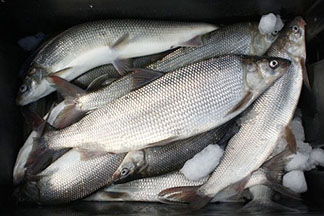
Photo Credit: Michigan Sea Grant

On the future of whitefish in parts of the Great Lakes Continue reading →

Knight Center alum investigates toxic plume in Ann Arbor

Elinor Epperson

What began as a professional project at Michigan State has turned into a feature project at Michigan Public radio.

Elinor Epperson spent 18 months researching, writing, fact-checking and editing a series of threelongform articles about the Gelman plume, an area of groundwater contamination under Ann Arbor that is several decades old.

The contamination comes from the disposal of industrial wastewater disposal by Gelman Sciences, a one-time medical filter manufacturer.

She also wrote a reporter’s notebook and appeared on the Stateside podcast to provide a more condensed version of the project.

Epperson earned her master’s degree in journalism from the MSU School of Journalism in fall 2024 and still works at the station as an intern.