Category Archives: Students

 
Journalism and non-journalism students at Michigan State University explore how to better report environmental issues to the public at the Knight Center for Environmental Journalism.
 

Environmental journalism courses can help students meet the School of Journalism’s elective requirements. They can also be used as part of an environmental theme to complete the school’s concentration requirement by combining them with environment-related courses outside the journalism program. See your academic adviser or contact the Knight Center.
 
Non-journalism students interested in environmental issues are encouraged to contact instructors to discuss waiver of pre-requisites. Often a journalism environmental course may meet communication course requirements of other departments.


Undergraduates are also encouraged to join the student Environmental Journalism Association and write for Great Lakes Echo to gain resume-building experience and clips.
 
Undergraduate students are eligible for several awards and scholarships in environmental journalism.
 
They are encouraged to augment their study with environment classes and programs elsewhere at MSU such as the Residential Initiative on the Study of the Environment.


INNOVATION

Software engineer questions what future scientific innovation looks like, how productivity is diminishing and what can be done

By Clara Lincolnhol

This is the 1st in a series of articles by Knight Center students who attended the recent annual conference of the National Association of Science Writers.

Is scientific innovation slowing down?

That’s what Cristian Ponce, the CEO of software development company Tetsuwan Scientific, asserts.

Cristian Ponce, CEO and co-founder of software development company Tetsuwan Scientific, speaks to a session of the National Association of Science Writers conference in Chicago. Credit: Clara Lincolnhol.

He also urges people to look into the effects that diminishing research productivity has on creating life-changing products like medications.

When William Shockley invented the transistor in 1947, that allowed the modern computer as we know it today to exist, Ponce said, speaking at the recent annual conference of the National Association of Science Writers in Chicago.

“Innovation in the transistor has enabled computers that are faster, more affordable, more energy efficient and much smaller in footprint,” he said.

There have been great jumps in technological innovation due to the development of transistors. These technological advancements coincide with many changes in society, he said.

“If we’re able to describe how the computer changes over time, we are able to describe in many ways how society changes over time due to computers’ important impact on our society,” Ponce told an audience of science journalists, writers and communicators.

In 1965, an engineer and business executive named Gordon Moore observed that the number of transistors in a circuit doubles around every two years at the same energy expenditure, leading to greater technological development. Continue reading →

Knight Center team attends science writers conference

Five environmental journalism students and Knight Center director Eric Freedman attended the recent annual conference of the National Association of Science Writers in Chicago.

They were undergrads Clara Lincolnhol, Emilio Perez Ibarguen and Isabella Figueroa Nogueira and master’s students Shealyn Paulis and Julia Belden.

Topics ranged from skill-building such as editor-freelance relations, using data in stories, making science videos and how reporters can conduct their own mini-investigations to issues such as the future of U.S. science, AI and data centers, nuclear weapons and the brain drain.

The students will be writing stories for the Knight Center website and Facebook page and the Journalism School’s Facebook page on lessons learned from the conference.

Also attending the conference from MSU were Knight Center master’s alum Ruth Thornton, university science public relations manager Emilie Lorditch, outreach specialist and MSU alum Ana Becerril of the Facility for Rare Isotope Beams and Angela Prete, a graduate student in microbial & molecular genetics.

 

High school students visit Knight Center

Troy Athens High School students

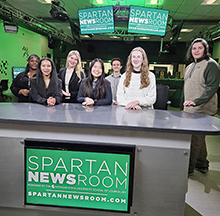
Students from three Southeast Michigan high schools recently spent a day at the Knight Center, learning about environmental journalism and touring the School of Journalism, the Spartan Newsroom and the WKAR TV studios.

Kelly House, the environmental reporter at the nonprofit Bridge Michigan news service, spoke to the students and teachers at lunch.

Skyline High School and Huron High School in Ann Arbor and Troy Athens High School received Knight Center grants for their journalism and environmental science students and teachers to develop collaborative media projects.

Huron High School students

As part of the grant program, the Knight Center also arranged for former reporters Nancy Hanus and Ron Recinto to serve as professional mentors to the teams.

In “Why Native Plants,” the Troy Athens team explored the push and rationale to use native plantings at the school district’s new construction sites. Here’s the presentation and video about the project.

The Huron team looked at how students used wildlife tracking cameras to study biodiversity and Miller Creek, which runs into the Huron River. Its presentation is here.

Skyline High School students

“Skyline’s Salamanders & Wetlands” is an account of ongoing efforts to protect an endangered salamander on the high school’s grounds. The team’s presentation is here.

Learning how with Great Lakes Now

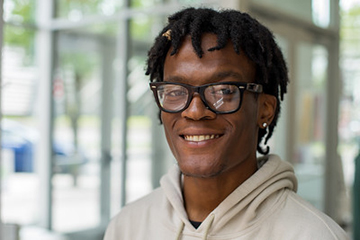
By Donté Smith

Donté Smith

After spending most of my time in the Michigan State University journalism master’s program honing my photography skills, in the last year I focused on developing my writing and storytelling.

Joining the Great Lakes Now team allowed me to apply these skills in a new way while learning new techniques, like creating social media content, to stay prepared for the ever-changing world of journalism.

Experiences with Capital News Service and Great Lakes Echo gave me the confidence to pitch new story ideas and suggest fresh concepts for existing pitches.

My photography experience was appreciated, and I benefited from being around other photo- and video-focused people. They gave me new ideas for capturing images and suggested gear that would help me get the right shots for a story. While serving as both the reporter and the photographer for assignments was challenging, it helped me grow in both areas.

Joining the Great Lakes Now team was intimidating at first.

Being under the Detroit Public Television (PBS) umbrella, the organization was facing challenges related to federal funding reductions. I commend the Great Lakes Now team for providing me with engaging experiences while dealing with these challenges.

This experience taught me how much the world of journalism is constantly changing and that organizations like PBS will need to lean on their community-based models to face these challenges. Continue reading →