DATA JOURNALISM

Storytelling with data: tips for success

By Julia Belden

This is the 2nd in a series of articles by Knight Center students who attended the recent annual conference of the National Association of Science Writers.
On a chilly November Friday, a gaggle of journalists recently huddled around tables in a hotel ballroom , attempting – with varying levels of success – to filter Major League Baseball salary data on a Google Sheet.

The goal? Equip science journalists attending the National Association of Science Writers (NASW) annual conference with new and powerful reporting skills.

Crunching numbers and wrangling spreadsheets don’t conjure the mental image that most people think of when they imagine journalists, but the aptly named sub-field of “data journalism” does just that, and more.

Adam Rhodes, the training director for Investigative Reporters & Editors, led the journalists – including a group from the Knight Center for Environmental Journalism – through a step-by-step process to clean, filter  and glean insights from datasets.

NASW data journalism photo: Investigative Reporters & Editors training director Adam Rhodes shows workshop attendees how to organize data in Google Sheets. Credit: Julia Belden

While modern data journalists typically do their work via computer, using data to discover and enhance news stories isn’t a new phenomenon, Rhodes said. For example, an 1848 story in The New York Tribune tracked milage expenditures of members of Congress, and journalist Ida B. Wells was the first to collect and analyze statistics about Black lynching victims in the U.S. in her 1895 pamphlet A Red Record.

Rhodes showed attendees where to find useful datasets online – government websites and reports are always sure bets – and how to prepare, or “clean,” the data for analysis. Continue reading

INNOVATION

Software engineer questions what future scientific innovation looks like, how productivity is diminishing and what can be done

By Clara Lincolnhol

This is the 1st in a series of articles by Knight Center students who attended the recent annual conference of the National Association of Science Writers.

Is scientific innovation slowing down?

That’s what Cristian Ponce, the CEO of software development company Tetsuwan Scientific, asserts.

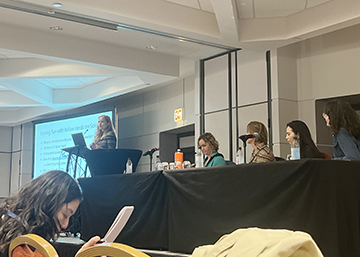
Cristian Ponce, CEO and co-founder of software development company Tetsuwan Scientific, speaks to a session of the National Association of Science Writers conference in Chicago. Credit: Clara Lincolnhol.

He also urges people to look into the effects that diminishing research productivity has on creating life-changing products like medications.

When William Shockley invented the transistor in 1947, that allowed the modern computer as we know it today to exist, Ponce said, speaking at the recent annual conference of the National Association of Science Writers in Chicago.

“Innovation in the transistor has enabled computers that are faster, more affordable, more energy efficient and much smaller in footprint,” he said.

There have been great jumps in technological innovation due to the development of transistors. These technological advancements coincide with many changes in society, he said.

“If we’re able to describe how the computer changes over time, we are able to describe in many ways how society changes over time due to computers’ important impact on our society,” Ponce told an audience of science journalists, writers and communicators.

In 1965, an engineer and business executive named Gordon Moore observed that the number of transistors in a circuit doubles around every two years at the same energy expenditure, leading to greater technological development. Continue reading

Knight Center team attends science writers conference

Five environmental journalism students and Knight Center director Eric Freedman attended the recent annual conference of the National Association of Science Writers in Chicago.

They were undergrads Clara Lincolnhol, Emilio Perez Ibarguen and Isabella Figueroa Nogueira and master’s students Shealyn Paulis and Julia Belden.

Topics ranged from skill-building such as editor-freelance relations, using data in stories, making science videos and how reporters can conduct their own mini-investigations to issues such as the future of U.S. science, AI and data centers, nuclear weapons and the brain drain.

The students will be writing stories for the Knight Center website and Facebook page and the Journalism School’s Facebook page on lessons learned from the conference.

Also attending the conference from MSU were Knight Center master’s alum Ruth Thornton, university science public relations manager Emilie Lorditch, outreach specialist and MSU alum Ana Becerril of the Facility for Rare Isotope Beams and Angela Prete, a graduate student in microbial & molecular genetics.


High school students visit Knight Center

Troy Athens High School students

Students from three Southeast Michigan high schools recently spent a day at the Knight Center, learning about environmental journalism and touring the School of Journalism, the Spartan Newsroom and the WKAR TV studios.

Kelly House, the environmental reporter at the nonprofit Bridge Michigan news service, spoke to the students and teachers at lunch.

Skyline High School and Huron High School in Ann Arbor and Troy Athens High School received Knight Center grants for their journalism and environmental science students and teachers to develop collaborative media projects.

Huron High School students

As part of the grant program, the Knight Center also arranged for former reporters Nancy Hanus and Ron Recinto to serve as professional mentors to the teams.

In “Why Native Plants,” the Troy Athens team explored the push and rationale to use native plantings at the school district’s new construction sites. Here’s the presentation and video about the project.

The Huron team looked at how students used wildlife tracking cameras to study biodiversity and Miller Creek, which runs into the Huron River. Its presentation is here.

Skyline High School students

“Skyline’s Salamanders & Wetlands” is an account of ongoing efforts to protect an endangered salamander on the high school’s grounds. The team’s presentation is here.